Last November, a bunch of University of Tartu geographers participated in the #30DayMapChallenge on Twitter: Evelyn Uuemaa, Anto Aasa, Tõnu Oja, Janika Raun, Alexander Kmoch, and UT Mobility Lab.
Three geographers – Tõnu Oja, Professor of Geoinformatics and Cartography; Evelyn Uuemaa, Associate Professor in Geoinformatics; and UT Mobility Lab – managed to make thirty maps in a row, one each day. Evelyn repeated her 2019 accomplishment, which was when Finnish GIS professional Topi Tjukanov initiated the challenge for the first time.
In 2020, at least 1378 people tweeted the hashtag. 797 people made 6,882 maps. Geographers used open data and open-source software to make the maps.
Here come 30 selected maps by the University of Tartu geographers, grouped by topic. They visualize both essential and fun facts about Estonia. Clicking on a map opens a larger view.
Population
1. Population map of Estonia
Population in Estonia. Data: Estonian Statistics. Map credit: Evelyn Uuemaa
2. Another population map of Estonia
Let’s repeat the population map in green. Data: Statistics Estonia. Map credit: Anto Aasa
3. Population map: Estonians and Russians
A population map, where each person is shown as a random point in a residential building. 2011 census data was used to differentiate between ethnic Estonians and Russians. Data: 2011 Population and Housing Census. Map credit: Ago Tominga / UT Mobility Lab
4. Expansion of Tallinn from the 13th C.
Data: Building registry. Map credit: Anto Aasa
Nature
5. Green infrastructure of Estonia
Green infrastructure encompasses forests, natural grasslands, semi-natural biotic communities, wetlands, and so on. Data: Estonian Environmental Agency, Hendrikson&Co. Map credit: Evelyn Uuemaa
6. Estonian rivers
Data: Estonian Land Board. Map credit: Alexander Kmoch
7. Standing waterbodies of Estonia
Data: Estonian Land Board. A pond for each and every Estonian? Map credit: Evelyn Uuemaa
8. Forest loss in Estonia from 2001 to 2019
The current analysis does not consider forest gain. It only shows proportional loss and disturbances. The areas where forest loss has happened are mostly still considered as forest land and forest regrowth can take place. Data: Global Forest Change (Hansen et al. 2013). Map credit: Evelyn Uuemaa
9. Air temperature on 13 November 2020
Estonia is small, but there is still variation in temperature. Data: Estonian Weather Service. Map credit: Anto Aasa
10. Climate change
In snowy winters, people follow the ski track. Map credit: Anto Aasa / UT Mobility Lab
Infrastructure
11. The electric grid in Estonia
Data: Land Board, Estonian Topographic Database. Map credit: Anto Aasa
12. The barrier effect of roads
The roads were extruded based on the traffic intensity. Data: Estonian Road Administration. Map credit: Evelyn Uuemaa
13. High chimneys in Estonia
High chimneys indicate where manufacturing is located. Data: Land Board, Estonian Topographic Database. Map credit: Anto Aasa
14. Number of companies in Tallinn
Data: Land Board; address data, Business Register. Map credit: Anto Aasa
15. Settlements with no bus stops
Data: GTFS. Map credit: Janika Raun
Agriculture
16. Population of humans and pigs
Data: Statistics Estonia, population register; Estonian Livestock Performance Recording Ltd. Map credit: Anto Aasa
17. Agricultural fields in Estonia
Data: Agricultural Registers and Information Board. Map credit: Tõnu Oja
18. Greenhouses in Estonia
Data: Land Board, Estonian Topographic Database. Map credit: Anto Aasa
19. Honey farms in Estonia
Data: Agricultural Registers and Information Board. Map credit: Evelyn Uuemaa
The Estonian language
20. Dialects in Estonia
The three most widely spoken dialects in Estonia – Võru, Saare, and Mulgi – are mapped as dots. One dot marks one person speaking the dialect at a random location in the respective territorial unit according to the 2011 census. Data: Estonian Statistics. Map credit: Evelyn Uuemaa
21. The isoline of Õ
One of the coolest peculiarities in the Saaremaa dialect is that instead of the Estonian vowel Õ they use Ö. The isoline marks the line where the change in the vowel is found. Historically, it was mapped by Theodor Kaljo in the 1920s. Map credit: Evelyn Uuemaa
22. Place names containing “saar” (“island” in Estonian)
Data: Land Board, Address data. Map credit: Anto Aasa
Tartu
23. Viewshed of the highest point in Tartu
Green shades indicate areas from which you should theoretically, under perfect weather conditions, be able to see the tip of the Tartu TV tower. Data: Landboard of Estonia. Map credit: Ago Tominga / UT Mobility Lab
24. Skyscrapers in Tartu
Data: Landboard of Estonia. Map credit: Ago Tominga / UT Mobility Lab
25. Bridges in Tartu
Data: Land Board, Estonian Topographic Database. Map credit: Anto Aasa
26. Movement of people in Tartu
The map is based on GPS tracking. Map credit: Anto Aasa / UT Mobility Lab
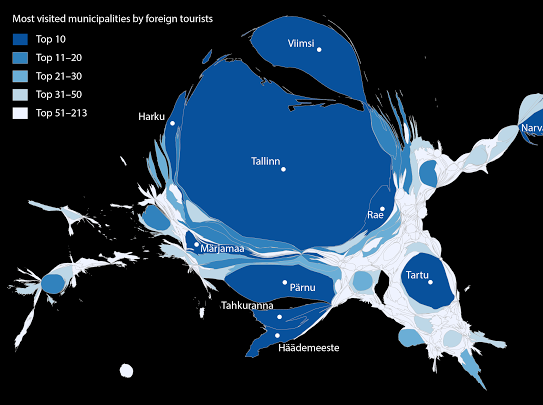
28. Most visited Estonian municipalities by foreign tourists
Most visited Estonian municipalities by foreign tourists in 2016, calculated from mobile phone data. The size of each municipality is distorted in proportion to the number of visits it welcomed. Data: Mobile Positioning Data. Map credit: Janika Raun / UT Mobility Lab
29. Painted Estonia
Map credit: Evelyn Uuemaa
30. Estonia in the style of Lord of the Rings
Estonia in the style of Lord of the Rings looks historical, but it’s a fantasy. Map credit: Evelyn Uuemaa
Are you interested in maps and geography? Our international master’s programme in Geoinformatics for Urbanised Society (MSc)may be a good bet for you. If you would like to study in Estonian, please check out our BSc programme andMSc programmein Geography.
This website uses cookies to improve your experience. We'll assume you're ok with this, but you can opt-out if you wish.AcceptRead More
Privacy & Cookies Policy
Privacy Overview
This website uses cookies to improve your experience while you navigate through the website. Out of these, the cookies that are categorized as necessary are stored on your browser as they are essential for the working of basic functionalities of the website. We also use third-party cookies that help us analyze and understand how you use this website. These cookies will be stored in your browser only with your consent. You also have the option to opt-out of these cookies. But opting out of some of these cookies may affect your browsing experience.
Necessary cookies are absolutely essential for the website to function properly. This category only includes cookies that ensures basic functionalities and security features of the website. These cookies do not store any personal information.
Any cookies that may not be particularly necessary for the website to function and is used specifically to collect user personal data via analytics, ads, other embedded contents are termed as non-necessary cookies. It is mandatory to procure user consent prior to running these cookies on your website.