
The authors of the story – Andres Saag and Tiina Randlane – are colleagues at the UT Institute of Ecology and Earth Sciences. The story also appeared in The Irish Times last Sunday as a part of the Atomium Culture project.
Protecting or sustainably managing wildlife in any part of the world is possible only if species are recorded and recognised not merely by specialists but also by the widest of audiences—by everyone.
Until recently, identification of species was mainly based on traditional, paper printed keys that comprise a series of questions, answers to which lead to the name of the species. Answers can be found by careful investigation of the characters of the specimen that one wants to identify. However, these keys have several drawbacks that have made the process of identifying species a boring and complicated business.
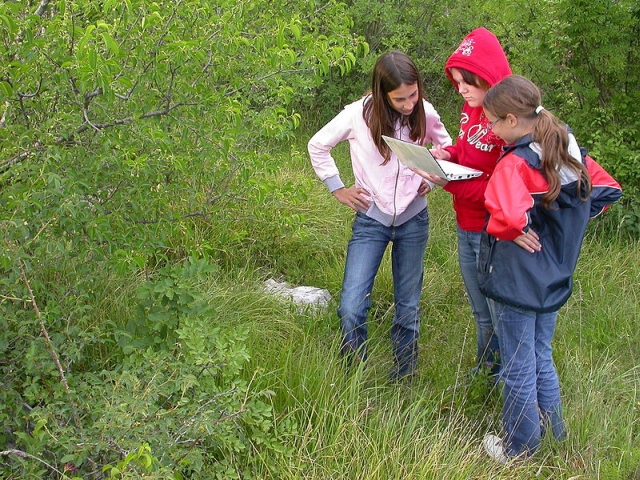
Identifying plants in the field with an offline identification key on a laptop. Image credit: KeyToNature.
Firstly, they are written by experts for other experts, often in ‘cryptic’ scientific jargon. In addition, composing a key is a time-consuming and strenuous intellectual exercise and as such even the most learned scientists make errors or just funny mistakes. For instance, a key for forest plants composed by a university lecturer started with the choice between two statements: “berries of the plant [that you are identifying] are poisonous” and “berries of the plant are not poisonous.” It is not known whether the users of this key are still alive…! Continue reading


