The Lost Switch (3/3)

This is the last installment in the 3-part series (don’t miss part 1 and part 2) presenting a selection of Edvin Aedma’s minimalistic art from his recent collection of short stories and graphic art entitled The Lost Switch (2010). Edvin graduated from the University of Tartu with a B.A. degree in semiotics and culture studies and later a Master’s degree in English translation (2009). He works as a freelance English-Estonian-English translator and is available for new translation contracts.

Destruction and a Grain of Sand

metamorphosis

Once upon a time, there was a grain of sand. She was as special as you are, or I am, and maybe even more so. She had once wanted to be a girl, once a boy. Then a fish, a bird, a rock, a tree, a cloud, a wheel, a violin string, music, the air that carries it, and finally, even life itself. And all the things and beings that could ever exist in the world.

And one by one, the grain of sand had tried being all of them. She had smiled as a girl, played as a boy, swam as a fish, flown as a bird, stood as a rock, grown as a tree, floated as a cloud, rolled as a wheel, breathed as air, sang as a voice and a violin string and finally, even been life itself.

Now she was again on the beach – among millions of other grains of sand. Continue reading

Posted in General | Tagged , , | Comments Off on The Lost Switch (3/3)

What Is Dark Diversity?

Biologists and conservationists usually deal with species found in a specific location. For example, they might count all the species found in a square kilometer.

new theory, published by University of Tartu ecologists in the March issue of “Trends in Ecology & Evolution”, considers the absent species in nature as important as the existing ones.

UT Professor of Botany Meelis Pärtel, Professor of Plant Ecology Martin Zobel and researcher Robert Szava-Kovats call species in the region that are absent, but that could potentially inhabit those particular ecological conditions, ‘dark diversity’.

Cosmology has used a similar term, ‘dark matter’, for decades to describe matter that can’t be seen or sensed but still makes up 80% of our universe. This dark matter interacts with visible matter such as stars and planets. A similar kind of interaction is going on in ecosystems.

Liverleaves in Estonia

Liverleaves in Estonia. Photo by Anneli Tandorf.

Continue reading

Posted in Natural and exact sciences, Research | Tagged , , , , , | 2 Comments

Concert: Ka Moosiga & Too Hot For Teacher

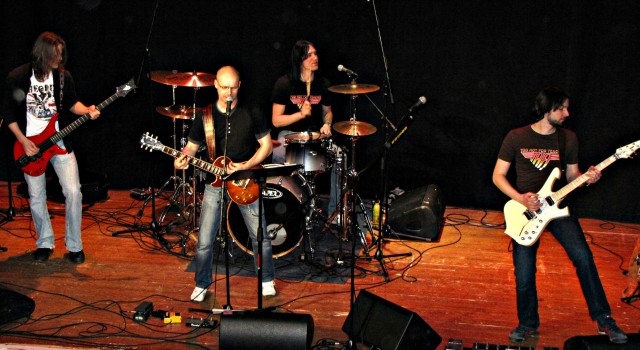
Ka Moosiga & THFT concert posterLast Friday, teachers and students were rocking the audience at the Athena Centre in Tartu. A hardrock band THFT (Too Hot For Teacher) got the show going while Ka Moosiga, comprised of our uni’s international students, a postdoc researcher and one Estonian, kept the stage hot after the break.

Too Hot for Teacher members:
Mikko – Vocals & Guitar, Martin – Drums, Mikey – Bass, Daniel – Guitar

Ka Moosiga members:
Vocals: Ivan Popov, Marco Gavazzi, Paolo Capurro
Guitar: Francesco Orsi
Bass: Remo Gramigna
Drums: Martin Jüssi

The night was a blast, and the bands are busy planning for their next concert.

THFT - Too Hot For Teacher

THFT (Too Hot For Teacher). Photo by Marta Majdecka

Continue reading

Posted in Events, Student life, Tartu | Tagged , , , , , , , , | 2 Comments

Your Personality Is an Open Book

female portrait

General belief has long held that part of our personality always remains hidden from outside observers. However, a team of University of Tartu psychologists recently conducted a survey of the Estonian Genome Project’s gene donors which seriously challenges this assumption. The study indicates that it is impossible to hide anything from a relative or a close friend. Continue reading

Posted in Estonia, Research, Social sciences | Tagged , , , | 1 Comment

The Lost Switch (2/3)

This is the second installment in the 3-part series (see part 1) presenting a selection of Edvin Aedma’s minimalistic art from his recent collection of short stories and graphic art entitled The Lost Switch (2010). Edvin graduated from the University of Tartu with a B.A. degree in semiotics and culture studies and later a Master’s degree in English translation (2009). He works as a freelance English-Estonian-English translator and is available for new translation contracts.

The Dog Who Smoked

I was walking on a trail next to a river when out of the corner came a humansized dog. He walked on his hind feet and wore an old-fashioned, long coat. He was puffing a large nasty-smelling pipe. He noticed me, stopped and coughed.

“I’m a writer,” the dog said in a coarse voice. Continue reading

Posted in General | Tagged , , | Comments Off on The Lost Switch (2/3)

European Football in The Iron Grip of Elite Clubs

This article was submitted to the University of Tartu’s popular science contest by Katarina Pijetlovic, a lecturer in EU law at Law School of Tallinn University of Technology and a researcher at the University of Helsinki.

football in flames

Thirteen years ago Silvio Berlusconi almost destroyed the traditional structure of European football when a company under his control, Media Partners International, made the ultimate indecent proposal to G14, the elite group comprised of the 18 richest and most successful football clubs in Europe. Continue reading

Posted in General, Research, Social sciences | Tagged , , , , , , | Comments Off on European Football in The Iron Grip of Elite Clubs

“Nothing in Biology Makes Sense Except in the Light of Evolution”

I’m a Mobilitas-funded post-doc in Tartu University, working in the lab of Tanel Tenson in the Institute of Technology. I write a blog about my research, and I’ve been kindly invited to write a guest post for the UT blog. I have very few opportunitites to explain my work to people outside of my immediate research areas, so I thought it might be a great chance to try introducing the research in a way that’s (hopefully!) accessible and (this is probably a long shot, I know!) interesting to people outside of biology.

The title is a quote from a 1973 essay by the evolutionary biologist Theodosius Dobzhansky. Although Dobzhansky was a theist, he understood that evolution and not creation is the only way to explain the weird and wonderful processes of Biology, and he was an advocate for the teaching of evolution in schools. Understanding the process of evolution can help us explain Biology on all scales, from molecules, to cells, to metabolic networks, to organs to whole organisms and to populations of organisms. I work on the small end of the scale, on evolution of molecules, proteins to be specific. Proteins are made up of chains amino acids, which are coded for in DNA.

You might be wondering why protein evolution is interesting or important. Of course every scientist thinks theirs is the coolest field (just like every parent thinks their child is the cutest), but it is pretty cool! I work on some of the most ancient proteins that function in some of the most fundamental processes in all life, and I’m trying to piece together what proteins were present in our ancestors and how they’ve evolved into their modern forms. It’s sort of like molecular archaeology, digging around for evidence of tools and mechanisms used by our ancestors or distant cousins. Like classical archaeology, we only have very few clues to go on. Only a fraction of genomes have been “excavated”, and many lineages have become extinct. But from those clues, we can retrace evolutionary histories and pinpoint significant events like gene duplication or horizontal gene transfer. Continue reading

Posted in Natural and exact sciences, Research | Tagged , , | Comments Off on “Nothing in Biology Makes Sense Except in the Light of Evolution”