Healthy Sleep Recipe: How, When, with Whom?

Sleep is important, but feels old-fashioned. Our lifestyle these days rarely takes sleep into account – we rather try to work as much as we can, then engage in some fitness training, and finally land ourselves in a club or pub. We pump ourselves with coffee in the morning and during the day, so life seems to roll on as if there is not much need for sleep. At some point we eventually feel exhausted, so we book expensive vacation trips and again spend our nights on the dance floor or elsewhere.

We seemingly invest in our health – by staying physically active, eating ecologically grown food, and taking vacations. However, besides all this, we forget what is most important – sleep. Sleep is equally vital to an artist, athlete, car salesperson, scientist, and every one of us. Good sleep helps us make the most of our lives. Let’s see why sleeping is so important and how to maximise its benefits.

sleeping Buddha

Sleeping Buddha. Digital art work by Hartwig HKD / Flickr Creative Commons

Why sleep?

To be honest, scientists are still not quite sure why sleep is so crucial throughout the animal kingdom. There are various theories about sleep function, but let’s just highlight two of them here.

One reason is that our brain cells need rest. They need rest because, contrary to our body cells, brain cells aren’t normally renewed. Although new brain cells are indeed born in a few regions of our brain and thousands of brain cells die daily, the large share of our hundred billion brain cells accompany us throughout our lives. Thus, sleeping gives individual brain cells some rest. One should not get the wrong impression here – during sleep the brain and the neurons are not switched off, they are still very much active, but in some sleep phases this activity permits “time-outs” for the single neurons. Continue reading

Posted in Medical sciences, Research, Social sciences | Tagged , , , , , | Comments Off on Healthy Sleep Recipe: How, When, with Whom?

What Is the Origin of the Slavs?

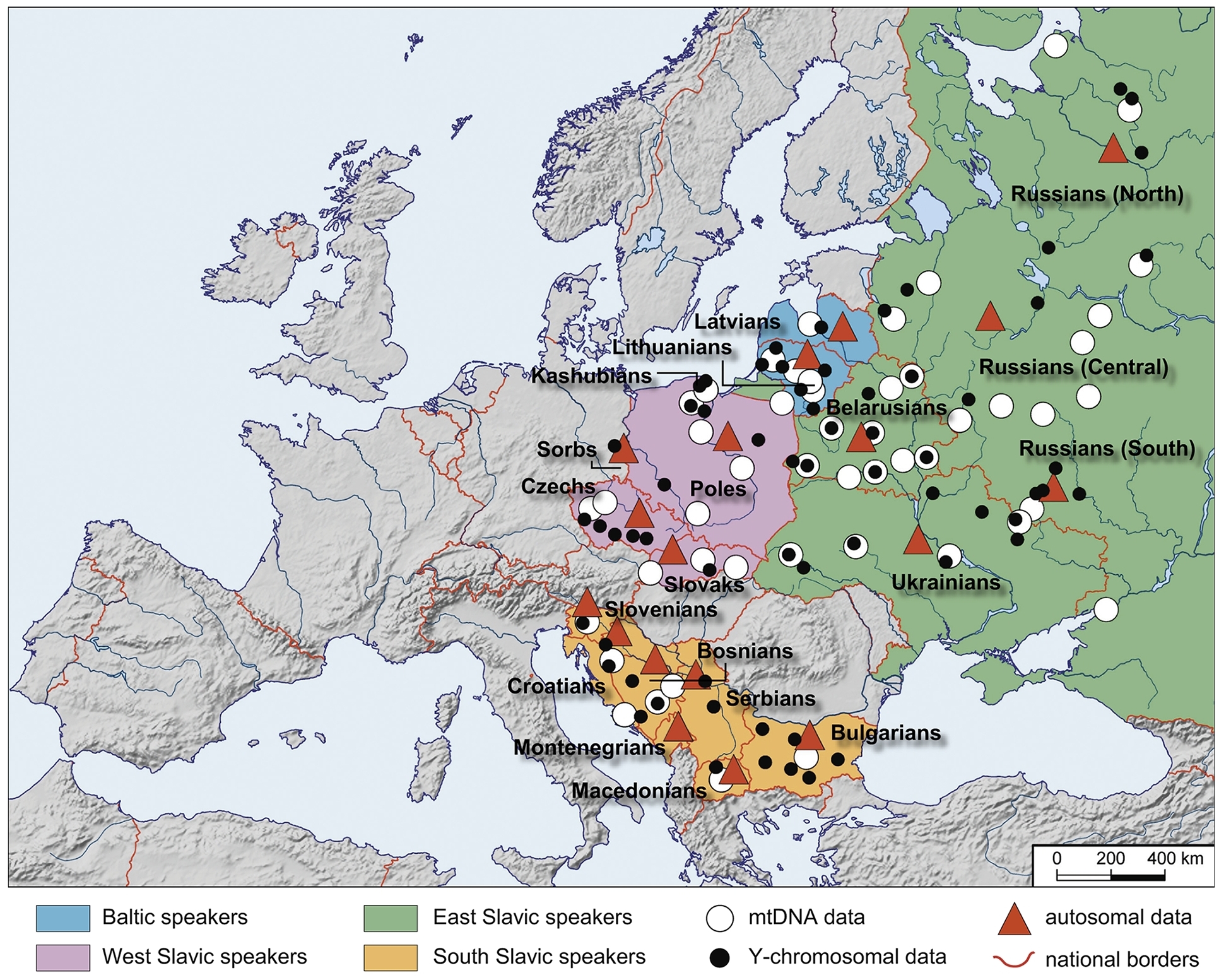
Every third European is a speaker of a Slavic language. By area, nearly half of Europe speaks Slavic. But who are the Slavic-speaking people by origin?

Girls dancing in the streets of Moscow.

Girls dancing in the streets of Moscow. Genetically, people who live in the rather large area from Poland in the west to the Volga River in the east are very similar. Photo Boris SV / Flickr Creative Commons

We know quite a bit about the Slavs from linguists, archaeologists, and historians. However, the advance of population genetics in recent decades adds a whole new dimension to the picture. The detailed genome analysis of the present-day populations reveals a lot about their ancestors and kinship.

The Great Migration – Slavs on the move

In the first millennium, much of Europe was on the move. The internal crisis and barbarian invasions challenged the Western Roman Empire. Between 300 and 500 AD, Germanic tribes such as the Goths, Vandals, Angles, Saxons, and others gained control of most of the empire’s areas. Between 500 and 700, other tribes, including the Slavs, pushed Germanic people westwards.

Historical records suggest that a major Slavic expansion across Europe took place in approximately 500–1000 AD. As mentioned, in Central-West Europe it affected groups speaking Germanic languages. In Eastern Europe it affected areas previously occupied by Baltic, Finno-Ugric and Turkic speaking populations; and in the Balkans populations of diverse linguistic affiliation.

Linguistic reconstruction supports the migration timing suggested by historians. Namely, the diversification of the Slavic languages into East, West, and South Slavic occurred around 100 AD. Intensive further diversification and development of individual Slavic dialects started around 500 AD.

Slavic speakers in Europe

The map shows the geographical distribution of Balto-Slavic populations within present-day Europe. 6,079 samples of Y-chromosomal data, 6,876 samples of mitochondrial DNA data, and autosomal data of 1,297 individuals were examined in the study. Image by Kushniarevich et al.

Continue reading

Posted in Natural and exact sciences, Research, Social sciences | Tagged , , , , , , , , | Comments Off on What Is the Origin of the Slavs?

Recipe: How To Make The Most of Your Brain

Sometimes people say that human brain is not fit for the tasks and challenges of today’s jobs. For me, the main problem is rather that we tend to use our brains very inefficiently.

The following principles make it easier to understand why the brain is not the ideal tool in today’s working environment, where people often try to monitor several information channels simultaneously, all while multitasking:

  • The brain likes immediate novelty — it likes Facebook updates more than everyday work. Updates in social networks are like candy that provides direct pleasure. On the other hand, in everyday work the rewards (paycheck, good words from colleagues) come only after several hours of hard work.
  • Due to our brain’s preference for novelty it’s really easy to disturb the brain — a glimpse of a new e-mail or a constructive remark by a co-worker are both the kind of things that can destroy concentration. They are both novel inputs that capture important resources.
  • One can already infer from the previous points that the brain is a really lousy multitasker by nature. Working tasks that require thinking are always approached in a serial fashion (one task after the other). Every time a work-related phone call occurs or some question from social media needs answering, the brain has to switch from one task to another.
  • Our conscious evaluation of our own abilities is often wrong. Some people think that they are superb multitaskers, although the facts prove this wrong.
  • After intensive slaving away, the part of the brain that was being used needs rest.
PET-image of human brain

The activity patterns of our brain depend on the task. Different tasks recruit somewhat different brain areas. Image by Jens Maus / Wikimedia Commons

Thus, in accordance with these principles, if you want to complete an important task at hand, then you are better off if you:

1. Concentrate on one thing at a time. Close down everything else (the browser, Facebook, mailbox, smartphone, a nosy co-worker). Disable all updates and notifications. Continue reading

Posted in Research, Social sciences | Tagged , , , , , , | Comments Off on Recipe: How To Make The Most of Your Brain

Psychology and Theatre

I met Andero Uusberg, a doctor of psychology, in the old cafe of the University of Tartu, now the Jazz Music Club run by Oleg Pissarenko. The breakfast costs just one euro. I really like it there – both the breakfast that costs you just a euro and the crazy musical choices.

I start by postulating that I went to the appointment interested in how theatre connects with people, what the rules are at hand, but we soon started talking about the ways in which psychologists are studying us, the people, nowadays.

Andero Uusberg

Doctor of Psychology Andero Uusberg. Photo by Raivo Tasso / Maaleht

It feels good to sit here. How do psychologists explain the word “mood”?

The first thing that comes to mind is that a mood is not the same as an emotion. An emotion always requires some kind of object that causes it, it is always a reaction to something. The same components causing an emotion are present, but not related so clearly to a specific object.

How about an example? Continue reading

Posted in Research, Social sciences | Tagged , , , , , , | Comments Off on Psychology and Theatre

University Will Not Make You Wise

Perhaps this is something you are not supposed to know yet, at least not before you have graduated from the University of Tartu – or, in fact, any university out there, no matter how big or small, famous or infamous, central or peripheral.

Mihhail Lotman, a member of the Semiotics Research Group at the University of Tartu and Professor of Semiotics and Literary Theory at Tallinn University, addressed his speech on this topic to graduates of our Faculty of Philosophy back in June. You may think it is not that timely to share it at the beginning of the new academic year, but sometimes a perspective on something yet to come may save you from false expectations and serve as guidance and inspiration.

What follows is the middle part of Mihhail Lotman’s speech, which you can watch in full length in Estonian.

Mihhail Lotman

Mihhail Lotman speaking to graduates of the Faculty of Philosophy on 26 June 2015. Photo by Andres Tennus

(…)

What did your studies give you? It depends on the expectations you had when you came here. I conducted a small survey and it turned out that very few come after something that I would say is available here.

Some came to become wiser.  I have to disappoint you right away: No one gets wiser at a university. Continue reading

Posted in General, Studies | Tagged , , , , , | 1 Comment

Academic Pilgrimage in the Steps of Kristjan and Eduards

Once upon a time, in the 19th century, there lived two young men. One of them was named Kristjan Jaak. He was an Estonian who was born in Riga and died in Riga, but in twenty-one years between those two occasions he managed to contribute so much to Estonian language that his birthday is now celebrated as Estonian Mother Tongue Day.

The other was Eduards. He was a Latvian who could not stand how wrong the socio-economic system of his time was, especially towards fellow Latvians; therefore, he wrote sceptical, pessimistic poetry and ended up studying law to help out the “little people” in general injustice.

flowers for Kristjan

Flowers for Kristjan — we got him “rukkililli” on our way to the graveyard. There was this old man in a completely random place where I have never seen anyone selling flowers in the Riga centre, and he had exactly what we needed — “rukkililled“. Photo from a personal archive

They lived a generation or two apart from each other, but both belonged to the academic family of Universitas Dorpatensis, each in his own time. I had already seen the monument to Kristjan on top of Toomemägi, when in one of my first Estonian lessons we were told that he actually walked from Riga to Tartu on foot to study. “An Estonian version of Eduards” was the first thought that crossed my mind, because even Latvians who have never read the poetry Eduards wrote tend to know that he too tended to walk the route and that for him education eventually turned out to be quite deadly. Literally.

Somehow this connection made me read more about both of them and the thought that I too could walk those two-hundred-and-something kilometres between Riga and Tartu became more and more insistent. After all, religious people make all kinds of pilgrimages for all kinds of reasons – why couldn’t academic people do it too? And what better destination for a Latvian student than the place where Latvians not only went to study but also built up the idea of Latvian-ness itself? After all, one of – if not the first – occasions when someone publicly declared that he considered him a “Latvian” was precisely in Tartu.

The more I fell in love with Estonia and Estonian culture through my weekly visits to Tartu, the more insistent the idea became, and eventually, somewhere in August 2014, I asked my fellow Estophile Lauma whether she would join me in such an adventure, mainly for the reason that alone I would not make it even to the departure point. She agreed without much hesitation. Continue reading

Posted in Estonia, Events, Student life, Tartu | Tagged , , , , , , , , | Comments Off on Academic Pilgrimage in the Steps of Kristjan and Eduards

Summer Interview with Top Ecologist Aveliina Helm

Aveliina HelmAveliina Helm, a member of the Macroecology workgroup at the University of Tartu, belongs to the top one per cent of the world’s most cited ecologists. Her summers are typically busy with fieldwork. This one was no exception – Aveliina spent most of it on the extremely species-rich grasslands of Estonia, observing the whole ecosystem from soil biota to birds.

Aveliina Helm’s perfect summer moment looks like sitting on the terrace, reading, watching children playing, dragonflies flying over pond and sheep grazing in the distance. Her top summer read was a book by the winner of the Nobel Memorial Prize in Economics Daniel Kahneman: ‘Thinking, fast and slow‘. Our interview happened on Twitter. Enjoy!

Continue reading

Posted in Estonia, Natural and exact sciences, Research | Tagged , , , , , , | Comments Off on Summer Interview with Top Ecologist Aveliina Helm