Scientific Practices in the Philosophers’ Looking-glass

Endla Lõhkivi is a Senior Lecturer in Philosophy of Science at the University of Tartu and the main organiser of the recent workshop: “Practical Realism – Towards a Realistic Account of Science”.

In the middle of June, philosophers of science from eight countries gathered in Tartu for a three-day workshop entitled “Practical Realism – Towards a Realistic Account of Science”. The workshop was organised by our university’s Chair of Philosophy of Science.

The topic and the background

Philosophy of science, established in its own right in the 19th century, has long been dominated by the so-called armchair approaches. From the armchair perspective, science was seen either as an area for collecting facts and making generalisations, or as making hypotheses and testing them in experiments.

Only few philosophers paid attention to the actual history of science, and even less to the particular practical experimental settings or cultural contexts. This changed radically due to the naturalist turn in philosophy in the last decades of the 20th century. Continue reading

Posted in Humanities, Research | Tagged , , , , | 4 Comments

“Excuse Me, Have You Fallen Down?”

A few days ago a bunch of photographers, cameramen and some people who were simply curious (including myself) overheard a strange dialogue:

– Excuse me, have you fallen down?
– Yes.
– I could not understand you. Excuse me, have you fallen down?
– Yes.
– Do you need help?
– Yes.
– The Health Call Center has been notified. Wait a moment, someone will be there shortly.

If you haven’t guessed yet, then one of the participants in this strange conversation was a robot. In fact, this is what makes the whole project unique and innovative: Namely, that built-in intelligence lets the robot engage in dialogue.

A test person, with sensors attached to his chest, threw himself on the floor to simulate falling down (in a pretty convincing way – he had probably rehearsed it).

In the beginning, nothing seemed to happen, but after the “patient” almost lost his patience, the robot finally realized that something was going on and began to approach the poor guy. Continue reading

Posted in Natural and exact sciences, Research | Tagged , , , , , , | 1 Comment

Who Dares Say Marine Life in the Baltic Sea is Grey?

The hidden colours of the Baltic underwater seascapes are revealed in the following selection of images captured by Carlos Minguell from Oceana, the largest international organization working to protect the world’s oceans, during the expedition to the Baltic waters in spring 2011.

Posted in Natural and exact sciences, Research | Tagged , , | 1 Comment

Estonia Considered A Loose Country

Estonia, together with the Ukraine, Hungary and Israel are cultures that may be considered to be quite loose in terms of socially accepted behaviours and tolerance, according to a study in Science magazine comparing 33 nations.

an old man swinging

Is swinging for kids only? What will others think of me? Photo: Annika Haas

The tightest countries (those that have many strong norms and a low tolerance for deviant behaviour) were Pakistan, Malaysia and India.

Anu Realo, senior researcher of personality psychology at the University of Tartu, was one of the authors of the article. She says researchers in the last few decades have tried to explain cultural differences on a scale of individualism and collectivism; however, this scale cannot explain everything.

The fresh survey is one of the first attempts to analyse tightness and looseness of cultures in the context of many different nations.

In the Estonian survey, participants had to evaluate whether there were specific rules of behaviour for most types of situations. It also studied whether or not Estonians had a large degree of freedom to decide how they want to behave in most situations. Continue reading

Posted in Estonia, Research, Social sciences | Tagged , , , , , , , | 2 Comments

A Secret Switch Governs Cell Division

The story is a synthesis of Villu Päärt’s article in Novaator and Ott Tammik’s coverage in the ERR News.

University of Tartu researchers have made new discoveries in the cell division cycle, which is one of life’s fundamental processes. This knowledge is essential in developing a more efficient treatment for cancer.

We all know that cells divide constantly. Cell division consists of a sequence of different complicated processes wherein exact copies of existing cells emerge.  The protein CDK is “in charge” of keeping these processes on track.

The research team led by biomedical technology researcher Mart Loog discovered that the protein CDK regulates the complicated cell division process sort of like an on/off switch and acts as a trigger that changes at different times during the process. Continue reading

Posted in Natural and exact sciences, Research | Tagged , , , | Comments Off on A Secret Switch Governs Cell Division

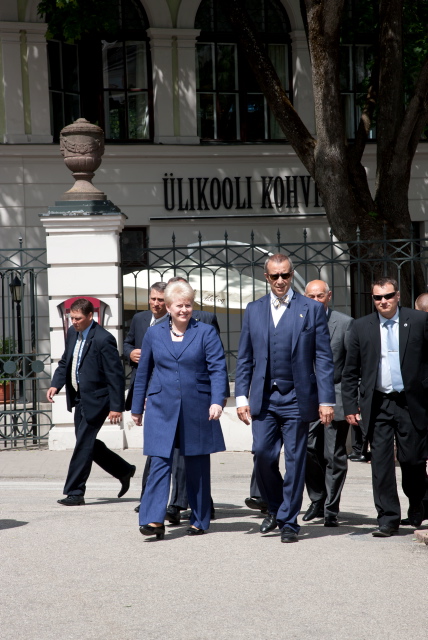
Gallery: The President of Lithuania in Tartu

We were honored to receive the President of Lithuania as our esteemed guest at the University of Tartu on June 17th. Her Excellency Dalia Grybauskaitė met President Toomas Hendrik Ilves and Rector Alar Karis, and made a surprise appearance at a graduation ceremony. University Photographer Andres Tennus captured some cheerful moments from the day.

University of Tartu Rector and President of Estonia

A small talk across the old border between the university and the city of Tartu: UT Rector Alar Karis and Estonian President Toomas Hendrik Ilves are waiting for their guest, President of Lithuania Dalia Grybauskaitė.

Presidents of Lithuania and Estonia in Tartu

Presidents of Lithuania and Estonia in a hurry on their way to the university's Main Building.

Continue reading

Posted in Estonia, Events, Social sciences, Tartu | Tagged , , , , , , | 1 Comment

How Safe Is a Time Stamp?

When digitally signing a message, we too often fail to consider the safety of the whole system, and the possibility that somebody else could use our signatures malevolently.

But what about digital time-stamping? The digital nature of our world raises questions as to how one can prove that a document or application was created at a certain time.

To give an example, Margus Niitsoo, a fresh doctorate from the University of Tartu’s Computer Science Institute, talks about the Patent Office. The Patent Office often needs to prove that documents have been received by a certain date and time of day, so that anyone who tries to register the same idea afterwards can be shown to have applied later.

“What if the patent clerk wants to cheat, and obtains the rights to a promising idea by changing the time stamp?” asks Niitsoo.

Prof. Ahto Buldas, Prof. Berry Schoenmakers, Margus Niitsoo, Prof. Helger Lipmaa, Prof. Dominique Unruh

Margus Niitsoo surrounded by professors: the supervisor Ahto Buldas and the opponent Berry Schoenmakers from the left, the opponent Helger Lipmaa and a colleague Dominique Unruh from the right.

Under the supervision of Ahto Buldas, professor of cryptography, Niitsoo’s doctoral dissertation focused on the safety of a time-stamping solution developed by the Estonian IT company GuardTime.

“I found a better way to measure the safety of time-stamping, so it can be performed faster. In a way, it’s as effective as it can be – there’s no pushing further.” Continue reading

Posted in Natural and exact sciences, Research | Tagged , , , , , | 2 Comments