Solving the puzzle of the Kurds in the Syrian conflict

“After historic victories against ISIS, it’s time to bring our great young people home!” wrote Donald Trump, President of the United States of America, on Twitter on 20 December 2018.

A barrage of fear, presumptions, and confusion resulted from the evening tweet, as the 55-kilometer-radius security zone in Syria where the US troops are based is a temporary retreat for at least 50 thousand internally displaced people (IDP) in the country. The tweet not only has international importance due to the number of IDPs living there, with the Syrian conflict raging on since 2011; the conflict has also created a refugee crisis unseen since the Second World War and has caused a rise in xenophobia and radical right populism in some EU member states, like Hungary and Slovakia.

The main reason why the tweet caused such a sensation on the international level is the possibility of changing power lines in the region, where Syria, Russia, Iran, Turkey, the US, and some other countries have their own concerns and are interested in their own dominance.

Currently, some areas in the northern part of Syria are under the control of Syrian Kurdish forces called the Syrian Democratic Forces, where American troops are working and fighting alongside the Kurds and Arabs engaged. What will happen with areas inhabited mainly by the Kurds, when the US pulls out its forces, in light of Russian forces helping the Kurds to patrol the area since the end of January? Where do the US troops stand
politically on this question and how much will the Kurds influence the division of the power lines in the region?

Who are the Kurds?

Continue reading
Posted in Research, Social sciences, Studies | Tagged , , , , , , , | Comments Off on Solving the puzzle of the Kurds in the Syrian conflict

The usefulness of medicinal plants is more than folktales

Ain Raal, Professor of Pharmacognosy at the UT Institute of Pharmacy, is the co-author of the recently published Estonian-language book, “Medicinal plants of Estonia”. The book is more than a treatise of folk medicine, as the authors provide a mythological and historical overview of plants, along with science-backed knowledge. The book describes the medicinal effect of many plants you can find in Estonian nature.

A juniper tree with its berry-like cones. Image credit: Alina Miroshnichenko, Unsplash

People being skeptical of modern medicine and looking for folk remedies is very topical in Estonia. The book might therefore be regarded as a step in the right direction by explaining scientifically why and how the plants can be useful. Here are some examples from the 80 plants described in the book.

Juniper

This plant is mostly seen near seashores in Estonia. It might look like a bush as well as a tree by its size and shape. Juniper is regarded as a magical plant because of the cross sign on the top of its berry-like cones, not to mention that one should use this conifer in the sauna for “whisking” oneself. Its health benefits are also recognized by the European Medicines Agency.

Continue reading
Posted in Estonia, Medical sciences, Research | Tagged , , , , , , , | Comments Off on The usefulness of medicinal plants is more than folktales

Tatiana from Moldova: How my dream came true

This story is about dreams and how becoming a student at the University of Tartu, Geoinformatics for Urbanised Society (MSc) showed me that all dreams come true if you have time and self-reliance.

Let’s start from October 2017. I had a dream TO STUDY ABROAD, and found out the University of Tartu’s interesting master’s programmes (trust me, these programmes are really interesting because I spent a lot of time on analysing and choosing the programme).

Basically, I met some of the requirements: bachelor’s degree, prerequisite courses, motivation; and the only issue was with English language proficiency. But wait, application deadline was 15 March, so I have enough time to prepare myself (I was thinking like that).

With my Upper Intermediate English, I started to search for TOEFL preparation courses near me.

At the first language center, TOEFL teacher was on maternity leave, but she helped me by recommending another TOEFL tutor.

Afterwards, I went to the second recommended center and took one test to assess my overall English. The feedback was that I need to take one more English course and only after that, start to think about TOEFL preparation and, if I want it so much, take the test in May 2018. But wait, what will I do with TOEFL in May if the application period will be closed?

And basically I didn’t need 120 points, I needed just the required minimum (TOEFL iBT – 75). After a little of crying, I decided to search for the next Language Center. The recommendation was the same, to take Advanced English and after that, TOEFL preparation course. I decided that I cannot wait and the only thing I can do is to go with TOEFL self-study.

I found one organization which provided to me all needed materials for free, registered for the TOEFL Test (January 19, 2018) and started to study every evening and listen to English books every morning while heading for work.

On that inspiring winter morning of 19 January, I was waiting for TOEFL exam to begin and dreaming about Estonia. And what happened in two weeks?

I also was crying, but now with happy tears, because I got 82 points for the test and that means I can pursue the next step: application.

Another day with happy tears was 27 April when I had received a conditionally accepted offer from the University of Tartu, regarding (MSc) Geoinformatics for Urbanised Society.

I also was crying (I’m just too emotional and this is a way which helps me to solve my problems), when I had to pay a refundable deposit for place in a dormitory via SWIFT Transfer (few banks refused to me to make this payment just based on accommodation offer) but luckily I met a kindhearted coworker who asked the reason of my tears and helped me to find a proper bank, so I made the payment.

It is also important to mention one great person (my boss at that time) who actually gave me job and I was able to work, to assure my living costs and have money to pay for the application fee (EUR 50). He also proposed to me financial support for TOEFL preparation course, but as you understood my problem was time not money, so I refused.

And here I am, Tartu – city of good thoughts, January 2019, working on my next “unachievable” dream.

Why Estonia?

If you are a part of that group of people who likes temperate climate and are inspired by winter, this is the right place for you.

If you are a part of that group who doesn’t like winter so much, then definitely you have to choose Estonia and see how warm and majestic could a winter be if you are surrounded by wonderful people (Estonians).

Why University of Tartu?

This is a place where lots of people work for you, for qualitative and joyful studies, and the most important – they will listen and support you to grow as a personality, and help you to overcome obstacles you may face on this journey.

Why Geoinformatics for Urbanised Society?

For me – I just read description of the programme and felt that I want it.

Now, after the first semester, I realize that by having skills in analysing and handling spatial data, you get a better understanding of how different processes work and affect each other. By applying all your GIS skills in solving a variety of problems, you can have a big contribution in making this world a better place. In addition to that, you will feel so comfortable surrounded by enthusiastic master students who also want to make this world a better place and fantastic lecturers ready to help whenever you need and share with you their best knowledge.

Posted in Estonia, Studies, Tartu | Tagged , , , , , , | Comments Off on Tatiana from Moldova: How my dream came true

Words of Wisdom at sTARTUp Day 2019

On the last day of sTARTUp Day, I met a Latvian entrepreneur over my modest lunch. We talked about machines taking over erratic humans in service and how it’s difficult for older companies to keep up with the times. I told her my story, and, before she left, she repeated several times: “Don’t give up!”

This is something I have heard before, and not long ago. sTARTUp Day – the biggest business festival in the Baltics, with 4,000 participants and a huge programme on three stages, plus a number of seminar rooms – started with a slackliner show. Jaan Roose shared his story after the performance. His piece of advice was something along the lines of: when you have failed again and again, ask yourself: Can I do it just one more time?

Swedish astronaut Christer Fuglesang, a guest of honour at sTARTUp Day, had the patience to train for over 14 years before he eventually got to space.

Continue reading
Posted in Career, Estonia, Events, Tartu | Tagged , , , , | Comments Off on Words of Wisdom at sTARTUp Day 2019

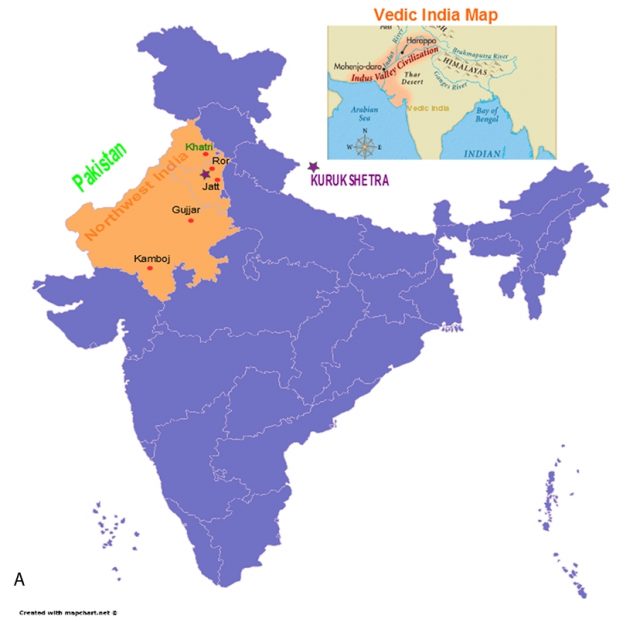
Genomic Study: Indian Rors Have Roots in West Eurasia

The geographic distribution and sampling locations of newly reported modern samples from Northwest India.
The geographic distribution and sampling locations of newly reported modern samples from Northwest India. An inset shows a map of Vedic India. Dots denote the samples studied, and green color indicates samples from published literature.

A new genomic study highlights the closeness of the Ror and Jat Indian population groups to populations residing west of India, including modern Europe. The study also suggests that the genetic heterogeneity of the contemporary Indus population possibly originates from the ancient Indus Valley Civilization period.

The Indus Valley Civilization was among the greatest early civilizations, alongside those in ancient Egypt and Mesopotamia. It extended across present-day Pakistan, deep into Northwestern India, and had major settlements established on the plains between the Indus and the Ganges basin.

Archaeologists consider the settlements of Mohenjo-daro, Harappa, Dholavira, Ganeriwala, and Rakhigarhi to be early cities of the Indus civilization. Harappa was such a rich discovery that the Indus Valley Civilization is also called the Harappan civilization. The Indus Valley has been the gateway to South Asia since ancient times. The civilization flourished in the Bronze Age during 3300–1300 BCE.

The study used DNA data from four Northwest Indian population groups — Ror, Gujjar, Jat, and Kamboj — whose long-term existence in the Indus Valley region can be traced back to the early Vedic scriptures. Previously published data on the Khatri community of Punjab was also used for the analysis. The study compared the newly generated data with the DNA data of the present-day global population groups and the ancient DNA data from groups such as West Eurasians.

Continue reading
Posted in Medical sciences, Research | Tagged , , , , | Comments Off on Genomic Study: Indian Rors Have Roots in West Eurasia

Researchers on controversial political ads by Eesti 200

Ads at Tallinn's Hobujaama tram stop on 7 January 2019.
Ads that appeared at Tallinn’s busy central Hobujaama tram stop early on Monday morning. 7 January 2019. Image credit: ERR

On Monday, 7 January

Early on Monday morning last week, commuters in central Tallinn faced bilingual advertisements dividing each side of the Hobujaama tram stop in half. The ads on the left, in blue, stated, “Here only Estonians” and the ads on the right, in red, stated, “Here only Russians”.

The ads also listed phone numbers to call with any questions – with a different number listed on each side.

When calling the number listed on the Estonian side, a prerecorded message said that Riigikogu elections were taking place on 3 March, where “they” would be running, and stressed that, “We, Estonians, definitely have to stick together; make sure you are standing on the right side”.

When calling the number listed on the Russian side, the same prerecorded message was played in Russian, stressing instead that Russians have to stick together.

While the tram ads spread like fire on social media, it remained unclear who was behind them. All attempts by media on Monday to determine the authors of the ads brought no results.

On Tuesday, 8 January

Ads at Tallinn's Hobujaama tram stop on 8 January 2019.
By Tuesday morning, the controversial ads at Tallinn’s busy central Hobujaama tram stop had been replaced by ads for a new political party, Estonia 200. 8 January 2019. Image credit: Urmet Kook/ERR

By Tuesday morning, the controversial ads had been replaced by ads for Estonia 200. The new ads, in Estonian and Russian, read, “Estonians and Russians: Attend the same school” and “Estonians and Russians: Attend the same party”.

Continue reading
Posted in Estonia, Events | Tagged , , , , , , | Comments Off on Researchers on controversial political ads by Eesti 200

The Intercellular Genetic Language Is Our First Language

Last December, Alireza Fazeli held his inaugural lecture as the new Professor of Clinical Genomics and Personalized Medicine at the University of Tartu. He presented his view on the burning issue of how cells communicate with each other and why we need to know about it.

Alireza Fazeli giving professorship inaugural lecture at the University of Tartu.
Alireza Fazeli giving the inaugural professorship lecture at the University of Tartu. Image credit: Andres Tennus / UT

Prenatal communication on the cell level

Let’s look at pregnancy and its most important stage – implantation. That is when the embryo attaches itself to the wall of the uterus. The big question about that is: how the does mother’s body recognize the child’s embryo?

This is where prenatal communication comes in. This is communication on a cellular level that requires a certain communication system, or language. Language elicits a reaction from whomever receives the “message”; it is a means of influencing someone or something.

Communication on the cellular level becomes important if we try to understand how different cells – like an embryo and cell of the uterus – recognize each other.

The uterus only has around two kinds of bacteria that can live there. Compared to the lower vaginal part, it hosts almost no other species. We can say that the uterus has a “high security level” because this environment actively defends itself against other organisms.

Our body’s defense mechanisms can include: avoidance with the help of the immune system; resistance with inflammation; or tolerance (coexistence). Therefore, if the uterus had any other defense reaction to the embryo besides tolerance, the implantation on days 8-9 (see image below) couldn’t take place and the pregnancy would halt. Only after the cells on the walls of the uterus have received the message that it is indeed the embryo is it allowed to attach.

 First week of pregnancy – attachment to the wall of uterus takes place on days 8-9.
First week of pregnancy – attachment to the wall of the uterus takes place on days 8-9. Image credit: Ttrue12 / Wikimedia
Continue reading
Posted in Events, Medical sciences | Tagged , , , , , , , , | Comments Off on The Intercellular Genetic Language Is Our First Language