My name is Aylin, and I would like to share all about my university experience and life in my course, so here we go!
Image credit: private collection
I come from Azerbaijan, and currently I am a second-year student at Tartu University. I study genetics and biotechnology here. I grew up in a medical dynasty: my uncle, both aunts, as well as great aunts and great uncles, have all had medical backgrounds. That’s probably also the reason why I knew I would have a profession related to medicine as soon as I developed self-awareness.
The urge to help people was in my blood. At the same time, the family did not force me to do anything. Initially, it wasn’t my dream to study genetics; I wanted to become a neurosurgeon. But by the time I graduated from high school, I began to get more and more interested in genetics.
Eight international students started studies at the University of Tartu Viljandi Culture Academy this autumn. Three of them are exchange students who stay here for one semester only and then continue studies in their home country, and five study Sound and Visual Technology in the two-year English-taught master’s curriculum at the academy.
Students of the University of Tartu Viljandi Culture Academy, Rufat Mustafayev from Azerbaijan, Jason Alexander Greenberg from the USA, Maren Irmelin Munthe-Dahl from Norway and Qumrosh Abbas Khan from Pakistan consider Estonians as friendly people and Estonia as a place to realise their dreams. Photo by Marko Saarm.
The master’s students of Sound and Visual Technology come from Azerbaijan, the United States of America, Russia, Pakistan and Bangladesh. Erasmus exchange students are from Lithuania and Norway and they study dance art, handicraft and metalwork. Krista Tamm, the academy’s International Relations Specialist, explains that besides their major discipline, international students also learn the Estonian language and culture.
We decided to find out what made these people come to Estonia and Viljandi and what they plan to do while they are here.
Rufat Mustafayev from Azerbaijan started his master’s studies in sound technology. He said he had applied to several European universities, including the Polytechnic University of Milan, but still chose the programme offered in Estonia, because it covers both visual and sound technology. In Italy, he says, it is possible to study music and acoustic engineering. “I decided in favour of Viljandi because in this industry, sound and visual art always work together and it would be good if I had experience in both fields before I start work,” Mustafayev explained.
He has previously studied in Turkey and Azerbaijan, and while pursuing his bachelor’s degree, worked as a volunteer at a Formula 1 stage and at European Football Championships. “By the end of my studies I already worked for those companies,” he says with pride. He is an active student, which is confirmed by the fact that Mustafayev has helped coordinate Erasmus projects in his homeland and often visited Turkey and Georgia in connection with these projects.
Of the two years he will study in Estonia, he plans to spend one semester in a Berlin recording studio to study how to create audio design for video games. This is his dream.
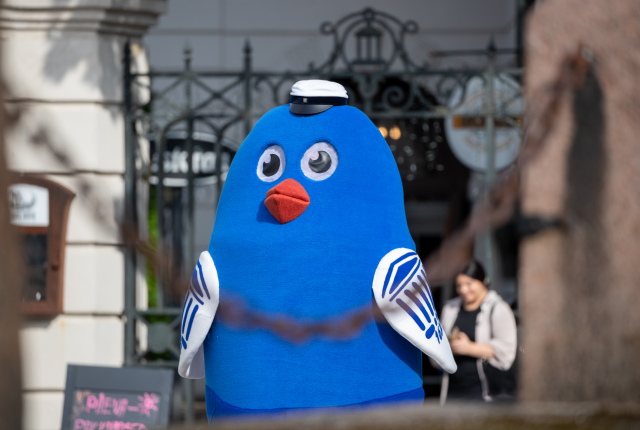
Last academic year, the University of Tartu organized a mascot contest that attracted a total of 97 submitted designs. The university family selected “Tiksu” by Lennart Rikk as the winner. The design of the mascot has now developed further, and at the end of August the live version of Tiksu was introduced.
Tiksu. Image credit: Andres Tennus
Legend says that Tiksu is a mystical bird said to have accompanied students at the window of a lecture hall for three autumn and spring semesters, and nobody really knows its species or origin. By nature, Tiksu is a curious and charismatic bird who wishes to represent the values and interests of the university family. Tiksu is now part of the university family and can be seen in some lectures and events all over the campus.
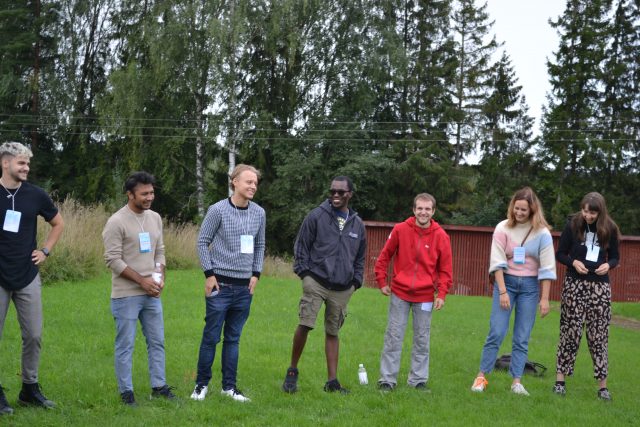
Fun activities with the crowd. Photo credit: Gerlin Gil
Weeks back I got an email inviting me for the Summer University 2021 – an event organised by the Federation of Estonian Student Unions (EÜL). I was to attend in my capacity as the President of the Association of African Students, Estonia (AASE). I was excited about the opportunity to travel to another part of Estonia, but I wasn’t looking forward to much networking with native Estonians, as my previous attempts have failed rather woefully. (Long story short: When I moved into my dorm space in last November, I was eager to make friends and tried picking up conversations with random strangers. I was particularly looking out for Estonian students, but discovered soon that most Estonians are not into small talk.)
The Summer University event was to be held for two days from 21–22 August at Voore Guest house in Jõgeva County. The Tallinn contingent of student representatives set out from Tallinn for the 2 hrs 30 mins journey. I and one other African student representative were received at the park by the Project Manager, and other than the occasional eye contact and polite nod, the journey was a quiet one for me, just as I expected – but this perception would soon be shattered by the affairs of the following 48 hours.
As mentioned at the beginning, the event was organized by EÜL, which is an umbrella organisation of students whose aim is to stand for the rights, needs, and interests of students at the national level and to support student unions in carrying out their work. The Summer University was very timely, as it addressed several topics that have bedeviled our various associations. Some notable issues and highlights of the event include the following:
A discussion session on discrimination of international students and how student councils should react;
A workshop on mental health without borders presented by Kristel Jakobson;
Presentation on the situation of international students by the representative of Eero Loonurm – Mari Liis Jakobson;
Deliberations on how to help students and chat about the way forward; and
A presentation by representatives of Integratsiooni Sihtasutus (The Integration Foundation) on multicultural society.
AASE made a case for the struggles of African students (especially new students), notably visa applications, accommodation, opportunities in the job market, and integration into the society, and at the end of the first day, it was clear to me that although international students have peculiar struggles, there are many challenges faced by all students, including Estonians.
I was shocked when (during the event) I had people walk up to me to pick up conversations. I was lucky to be paired in a room with an Estonian student who is probably the most energetic soul I’ve met since moving to Estonia November last year. He was versatile and told me the history behind everything.
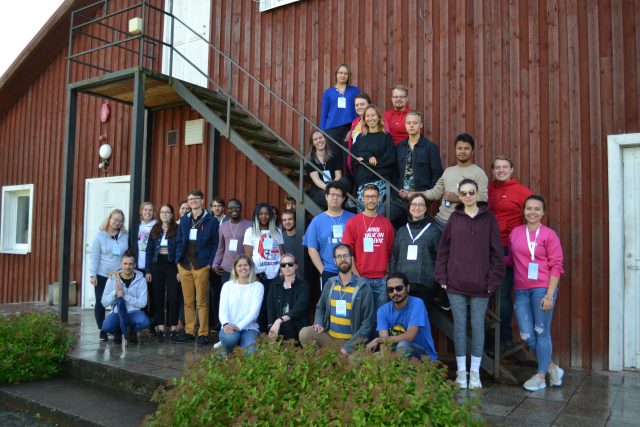
Participants of the Summer University 2021. Image credit: Gerlin Gil
We had fun field activities, and in no time I had found a basis for conversation with students interested in geopolitics and my home country, with a brilliant chap working in an awesome startup, recommendations for where to find suitable internships, and suggestions on how best to learn the Estonian language. We spent most of the late evening at the sauna and playing games, and I think I picked up more Estonian words in one evening than I have in my last six months of trying to learn at home. I took one valuable lesson home: Estonians are not difficult people provided you are willing to identify areas of mutual interest and are prepared to meet them halfway… in the sauna. 😊 So if you haven’t found a “common language” with Estonians, please don’t lose hope; rather, be ready for surprises.
The Summer University was a part of EÜL’s project, “Growing Ties: Student Democracy in a Transnational Era”, which is supported by Mondo, the European Commission, the Estonian Ministry of Foreign Affairs, the Estonian Ministry of Culture, and the National Foundation of Civil Society (KÜSK).
As humans, we are able to adjust in constantly moving environments, but it sure takes time and effort. Every individual experience shapes how one adapts in a new environment and overcomes the stress related to the adjusting period. In this article, the focus will be on how to adapt in new situations, including in university, and how to manage study-related tensions.
A new academic study year has begun, and most students feel that they are in a traffic jam full of obstacles, challenges, novelties, and uncertainties, emotionally overwhelmed by all these stressors. However, it is absolutely OK to feel all that, because whether this is a first time experience – being away from home or going back to study after a break – starting university life is a time of great change, but at the end of the day you will learn how to cope with these changes.
Adjustment to change
The ability to adjust to new situations or environments is an important phase in one’s development. Based on the context, this term is interpreted differently. Within this topic, adapting is a process by which an individual is able to cope with the demands/requirements of the external and internal environment, one of which is stress management (Kallasmaa, 2003), as is the process of matching, establishing, and maintaining relationships.
When entering university or starting a new academic year you might face unexpected challenges. To understand and better describe what one is experiencing through the adapting period, several theorists have differentiated phases of adjustment. For example, cultural researcher Geert Hofstede distinguishes four main stages in the adjustment to an unfamiliar environment. The duration and intensity of the stages depends on the person and to what extent the new environment differs from the person’s original place. In addition to the four main stages, the fifth also deserves attention.
Adjustment stages upon entering university. Chart Credit: Counselling Centre of University of Tartu
1. Euphoria or “honeymoon”. In this phase, the person feels positive and excited about the new environment, and has high expectations for the future. This is experienced by a person who has wanted to go to a new cultural space, and coming to university is usually just such a free choice.
2. Disappointment or culture shock. The first difficulties and crises. The new situation may not fully meet expectations; one may not succeed in building relationships and is confused by having to manage large amounts of information and new rules of conduct. This leads to dissatisfaction, impatience, anger, sadness, feelings of loneliness and incompetence, etc.
3. Acceptance of, getting used to, learning from the new situation. Gradually, one develops an understanding of the rules and norms; is no longer afraid to experiment; is more social and open again; the sense of humour re-appears and a certain psychological balance emerges.
4. Adjustment or integration with the new culture. One feels confident in the new environment and copes well; the sense of belonging has increased. Self-definition is clarified and the person acts purposefully.
5. Reverse culture shock may occur on returning to one’s home culture (or city). One may find that things or people have changed, or they themselves have changed to an extent that they no longer adapt to their former life environment.
Hereby, it is important to emphasize that adjustment stages are used mostly in a cultural context where one leaves a home country (city) and starts a new phase in a new culture. Nevertheless, these phases can also be applied to university life.
Early morning quarantine trip to lake Pühajärv. Image credit: private collection
I believe all students have found themselves looking at their timetables and wondering which lecture will be taken to the online format sooner or later. September starts in a few days, but the coronavirus situation is not much brighter than last autumn. Fortunately, we now have the opportunity to get vaccinated, and thanks to this, I’m more hopeful when thinking about the upcoming autumn.
When the pandemic took the stage in 2020, the situation was rather desolate precisely because we knew so little. As a new medical student, I had to figure out a way to study to become a doctor at home in the company of textbooks. In addition to the major changes in the organisation of studies, I had to think about how to protect my family from the virus. One of my family members has immunodeficiency, which means that from the moment the emergency situation was introduced, we almost never left the house. Couriers helped to fill the fridge with groceries, we searched for the emptiest hiking trails and kept contact with friends only by video bridge. Ideally, it was supposed to be the reality of all people to curb the virus, but, naturally, there is a limit to how long a social creature can stay in total isolation. We managed to do that for more than two months, because life depended on it.
Summer brought along somewhat different normality, although we knew that a new and stronger wave would come in the autumn. In the autumn semester, contact studies indeed resumed for the most part, but all around us, preparations were made for the imminent distance learning. However, the motivation to study at the university also largely depends on the people around us, who will most likely be our future colleagues, and this is why distance learning is not the best option. Besides medical studies, I have a great passion for dancing, and in early autumn, I took part in the rehearsals of a dance performance, but had to stop that because the risk was too high. I needed to avoid falling ill, and, even more so, taking the virus home with me.
When the news finally came that COVID-19 vaccines were on the way, I felt a childish pleasure, like getting a Christmas present. Although I knew the vaccine would not reach me any time soon, it gave me hope that we can return to something resembling normal life at one point. In March, medical students got the opportunity to get the vaccine, first those whose studies took place at the hospital already, and then the rest of us who wanted the vaccine. I, too, received my first shot in March. It never crossed my mind not to get vaccinated. I have also taken the flu vaccine every year, as vaccination is one of the most effective ways to protect myself and others from various vaccine-preventable infectious diseases. Thanks to this, I can now feel a little more relaxed at home because I know I’ve done everything I can to protect my loved ones.
I want to point out that while it is important that we all receive a quality education, build strong relationships and have access to everything essential, it is even more important to keep people around us safe. Especially those who would like to protect themselves, but whose well-being largely depends on the people around them. Therefore, it is everyone’s responsibility to get vaccinated against the coronavirus and, by that, help and protect others.
Sooner or later, we as students face a new, challenging task in our lives – finding a job. Some get lucky and have success during the first years of university, some need to fail 1000 interviews to succeed in one, while others do not care about finding a job until they graduate.
I am not a career expert, but I am a student of Tartu University (Innovation and Technology Management Program) who works at the Estonian company Fortumo as a Product Owner. In this article, I will share my story of finding a job in Tartu, as well as some advice from other international students.
For your convenience, I structured my story into two parts: learning about work opportunities and getting hired. Enjoy the read!
Me at the office. Photo credit: Private collection
Learning about work opportunities
I will share the truth. I did not want to look for jobs at all when I was starting to study Innovation and Technology Management for three specific reasons:
I had a part-time job at NMS as a project management assistant.
After 2.5 years of working full time and studying full time in Kyiv, I wanted to have a proper student life.
I was afraid that the study workload would be too high to combine it with full-time work.
This website uses cookies to improve your experience. We'll assume you're ok with this, but you can opt-out if you wish.AcceptRead More
Privacy & Cookies Policy
Privacy Overview
This website uses cookies to improve your experience while you navigate through the website. Out of these, the cookies that are categorized as necessary are stored on your browser as they are essential for the working of basic functionalities of the website. We also use third-party cookies that help us analyze and understand how you use this website. These cookies will be stored in your browser only with your consent. You also have the option to opt-out of these cookies. But opting out of some of these cookies may affect your browsing experience.
Necessary cookies are absolutely essential for the website to function properly. This category only includes cookies that ensures basic functionalities and security features of the website. These cookies do not store any personal information.
Any cookies that may not be particularly necessary for the website to function and is used specifically to collect user personal data via analytics, ads, other embedded contents are termed as non-necessary cookies. It is mandatory to procure user consent prior to running these cookies on your website.