Brave New World of Scientific Publishing

Jüri AllikJüri Allik, Professor of Experimental Psychology at the University of Tartu, belongs to the top one per cent of the world’s most cited scientists in his field. His recipes for becoming a top researcher were among the top 10 most popular posts on our blog in 2013.

This is the first post in Professor Allik’s revealing three-part series on scientific publishing.

To publish, or not to publish?

scientific journals

Few people could imagine the normal working day of a scientist. A scientist is imagined as wearing a white boiler suit and thoughtfully examining a test tube, with all kind of gadgets in the background. Actually, even an experimenter spends most of his or her time at the computer, answering emails or filling out often pointless write-ups and forms.

The older one gets, the less time that will go into research, and more time each day is spent making the results of the research public — also known as publishing. One of the ways to publish something is by going to a conference and presenting results there, be it an oral or visual presentation.

But one can seldom be a key performer at a big conference with thousands or more in the audience. Usually, just a couple of good acquaintances come to listen to your report, in addition to some diligent Japanese or Chinese, to whom you could have said everything in an evening with a glass of wine. It’s also bad that sometimes it’s possible to pretend to have message when, in fact, there isn’t one.

The most efficient way to report results is still through an article in a good, well-read journal. It’s possible that those in the humanities might be an exception, as they may consider anything less than a book not even to be a text; however, I have my well-grounded doubts about this as well. Continue reading

Posted in Career, General, Research | Tagged , , , , , , , , , | Comments Off on Brave New World of Scientific Publishing

My Farm Is My Stage: Insights into Estonian Rural Tourism

Ester Bardone is a researcher at the Department of Ethnology of the UT Institute for Cultural Research and Fine Arts. Recently she defended her thesis, “My Farm is My Stage: A Performance Perspective on Rural Tourism and Hospitality Services in Estonia”, and now continues studying rural tourism and hospitality entrepreneurship in Estonia. 

smoke sauna at Mooska

The sauna experience is a commodity to sell to an urban tourist. Eda, the hostess of Mooska Farm, is explaining to the guests the story behind a pictogram attached to her smoke sauna. Image credit: Ester Bardone

Why the performance perspective?

When I started my dissertation project I often heard comments such as: Why do you think rural tourism entrepreneurs are performing? Do you mean that they are deceiving their clients? You should study real rural life, not these fake attractions created for tourists! These assumptions reflect the challenges a researcher always has to face when getting involved in using theatre as a metaphorical analogy for describing social life.

Estonian Travel GuideTouristic representations of rural life, in turn, often amplify such assumptions, creating idealised or idyllic images of rural life, such as this image on the right, which is the cover of the Estonian Rural Tourism Association’s travel guide from 2009.

However, for my research, the performance perspective to rural tourism business did not mean merely describing similarities between theatrical performances and tourism services. It also included taking an interdisciplinary challenge and making sense of culturally complex processes, in Estonia as well as in the European Union, in which performing rurality emerges. Continue reading

Posted in Estonia, Humanities, Research | Tagged , , , , , , , , , | Comments Off on My Farm Is My Stage: Insights into Estonian Rural Tourism

Russian Federation 2014: A Difficult Year Ahead?

This post is authored by Viacheslav Morozov and Karmo Tüür, UT political scientists who led an expert network that produced a new collection of short-term prognoses of Russia’s political, economic, and societal development in 2014.  

Ballet Gala in Sochi 2014

What will Russia offer the world and its own people in 2014? In the photo: Ballet Gala in Sochi on 8 February 2014. Image credit: Ivan Klimychev / British Council Russia

In recent years, Russia has not been static, monolithic, and uniform. Russia’s economy has grown to become the sixth largest in the world, fuelling a corresponding rise in its ambitions. Russia’s desire to build a Eurasian Union around itself is a captivating puzzle for political scientists and everyone interested in current international developments. Domestic processes in Russia are also constantly changing, whatever our opinion of these developments might be. The long search for a ‘national ideology’ in Russia is finally taking shape around the idea of the nation state aspiring to become a regional power with a solid internal structure, stressing conservative and traditional values.

At the same time, the most notable feature of this year’s collection is undoubtedly the rather pessimistic tone of most forecasts, particularly those dealing with the domestic situation. Continue reading

Posted in Research, Social sciences | Tagged , , , , , , , , , , | Comments Off on Russian Federation 2014: A Difficult Year Ahead?

Why Do We Dream?

Jaan-AruJaan Aru is a researcher at the Computational Neuroscience Research Group and at the Talis Bachmann Lab at the University of Tartu.

Anyone who suddenly gets an urge to attack a scientific problem that is interesting, intriguing, and ‘big’ might end up with the question ‘why do we dream?’. This question seems so simple, but as it stands we still do not have a good answer for it. As expected, this topic has attracted the attention of many scientists and thinkers, so that there are already several theories around about dreams and their functions.

As a great writer, Sigmund Freud managed to popularize the view that dreams represent unfulfilled wishes that creep up from our subconscious. Freud believed that there are special processes which try to disguise the unfulfilled wishes before they emerge in dreams. This would explain why our dreams are sometimes bizarre. However, in general these ideas of Freud do not have much credibility when the contents of dreams are subject to scientific analysis.

On the other end of the spectrum, Allan Hobson has argued that dreams do not represent anything at all – they just reflect the random activity patterns of the brain. This theory is probably also too extreme, as dreams clearly have a structure in space and time and the dream content often corresponds to the everyday activities of the dreamer.

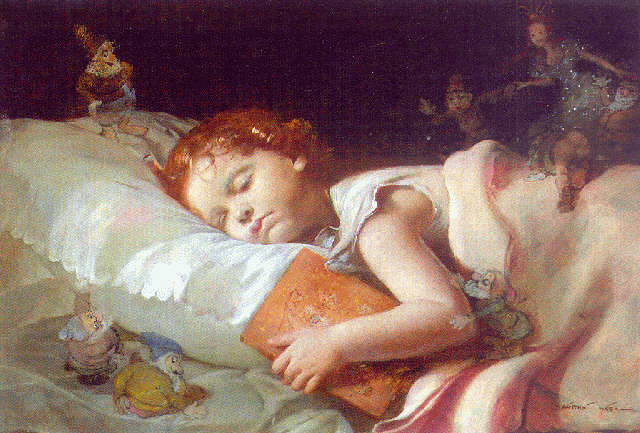
Sweet dreams dreaming of snow white and the seven dwarves

What happens in our dreams? A painting by Franz Schrotzberg: “Sweet dreams dreaming of snow white and the seven dwarves”. Image credit: Wikimedia Commons

Continue reading

Posted in Medical sciences, Research, Social sciences | Tagged , , , , , , | Comments Off on Why Do We Dream?

10 Tongue Twisters To Get You Started on Estonian

You may have heard or experienced that Estonian is not the easiest language to master. It sounds and is composed unlike most other languages, which means that English, German, Spanish, French, or Russian are more similar to each other than any of them are to Estonian. Spoken by just about one million people, it may sound like a strange language of elves. Remarkably, Estonian has no sex and no future (well, grammatically).

While all of this might be a perfect reason NOT to learn Estonian, it might as well be just the opposite.

So, how to get started on this peculiar and irregular sign system? Normally, you would start learning a language from the basics: phrases like ‘Hello’, ‘My name is John’, ‘I am a woman’. With a tough language like Estonian, why not take a reverse approach and attack the most challenging part first? Try to learn the words and phrases that sound almost unimaginable and likely non-existent to most non-Estonians — a source of great joy and fun for native speakers.

If you manage to learn and pronounce some of these tongue twisters, then congratulate yourself – the rest of Estonian will be more like a piece of cake, and most importantly, nothing will be able to scare you off your learning track if you are determined to pursue it. And, if it’s not your cup of tea, you have at least had some fun.

So, ready? Let’s give it a shot.

1. Kuuuurija

kuuuurija


Continue reading

Posted in Estonia, General, Studies | Tagged , , , , | 11 Comments

How Old Is Your Body?

Fitness-wise, a thirty-year-old with big gut may belong in the pre-retirement camp. A top-form amateur athlete, on the other hand, can be compared to the average at 25 years – at 70.

For some years now, scientists at the Norwegian University of Science and Technology in Trondheim, led by Professor Ulrik Wisløff, have tried to find a way to measure the physical fitness of a person without relying on expensive sport medicine labs. Load tests are performed in sport medicine centres, which means that they are not available to everyone – at least without waiting in a queue, which can often take many months. Also, such studies involve paying a substantial amount of money, enough to afford a decent pair of sneakers or to go to a sport club for couple of months.

The Norwegians’ study was inspired by the fact that sport medicine inquiries are far from being available to everyone, while physical fitness remains one of the clearest indicators when evaluating cardiovascular health.

The Norwegian researchers used portable labs, complete with the equipment needed to carry out a load test, to examine nearly five thousand individuals, aged 20 to 90. Various data about the guinea pigs was gathered, including height, body mass index, resting heart rate variability and cholesterol levels. Additionally, all participants filled out an in-depth questionnaire about their lifestyles.

A load test followed with the participant running on a treadmill as his/her maximal oxygen uptake (VO2 max) was measured. This indicator shows how successful the body is at transporting oxygen to the cells.

Tartu Marathon

Held in February, the traditional Tartu Marathon attracts large crowds of professional and amateur skiers of all ages. Image credit: Jaak Nilson.

Continue reading

Posted in Medical sciences, Research | Tagged , , , , , | Comments Off on How Old Is Your Body?

Are Open Notebooks the Future of Science?

The first Western science journals in the world — Journal des Sçavans in France and England’s Philosophical Transactions of the Royal Society — will turn 350 years old next year.

The science journal has, as a communication system that owes thanks to the printing press, brought about some quite peculiar situations. According to Jan Nolin, professor of information sciences at the University of Gothenburg, many habits of today’s science can be defined as ‘paper constructs’. Although scientists have adopted digital technologies when it comes to publishing the results of their studies, they still cling to paper – or electronic forms imitating the medium. The limitations inherent to paper as a medium have limited and shaped the philosophy of how science could and should be practiced, Nolin writes. Now, by redefining the medium, we define again what ‘science’ actually means.

Australian quantum physicist and publicist Michael Nielsen implies in his essay from five years ago that the most open system for trading information in the 17th century is now holding back more efficient solutions, as paying for publications in journals, not the new media, is still the norm.

He also says that the Internet has significantly increased the part of useful knowledge created by scientists that happens to be publishable. Nielsen says the greatest change in the creative process after the invention of writing is going on right now, with scientific publishing houses turning from service providers into technology companies.

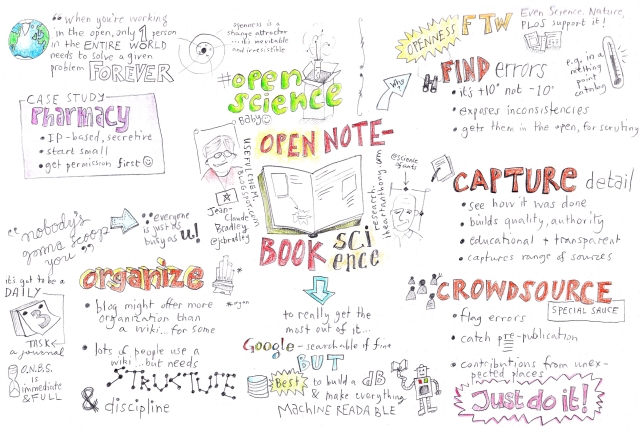
According to Nielsen, the ideal criterion for science would be extreme openness: making as much information of different kinds public, as well as readable, not only for humans, but machines as well. I studied one such experiment a bit. It might be a little too raw but it proves interesting nonetheless, and it’s called ‘open notebook science’. Time for some notes I made.

open notebook science

Open Notebook Science. Image credit: Matt @kwinkunks, Flickr Creative Commons


Continue reading

Posted in General, Research | Tagged , , , , , | Comments Off on Are Open Notebooks the Future of Science?